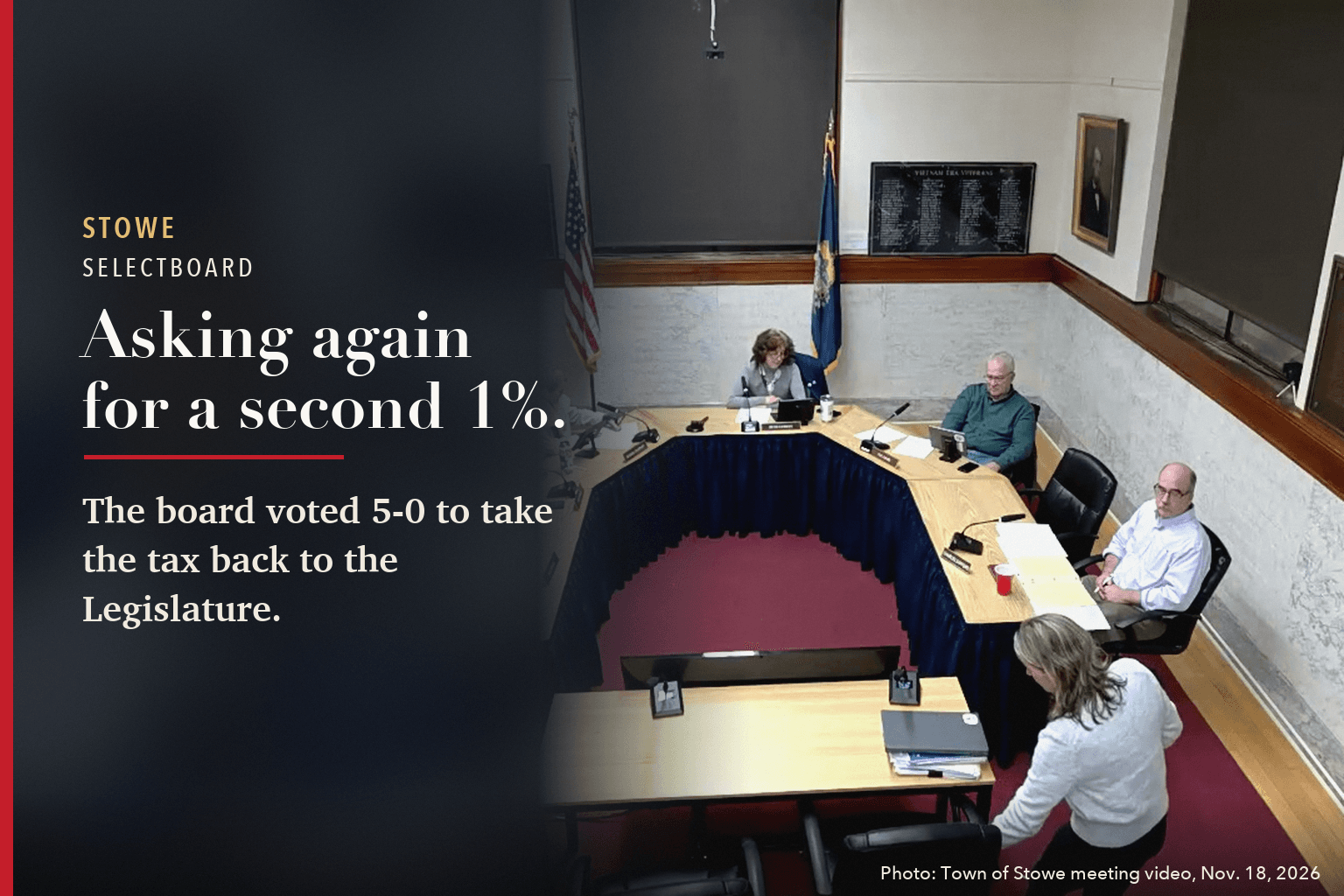
Stowe will ask the Vermont Legislature again for the power to double its local option taxes, the town's own 1% added to the state's taxes on sales and on meals, rooms and alcohol. The town's state representative told the Selectboard that most of the money would come from visitors.
The Selectboard voted 5-0 on Wednesday, Nov. 18, to ask state Rep. Jed Lipsky to reintroduce the charter change Stowe voters approved at Town Meeting this year, and to back the Vermont League of Cities and Towns in its push to let any town add the second 1% by a town vote. Town staff estimate the second 1% would raise about $3.5 million if Stowe keeps 75% of it, or about $2.4 million if Stowe keeps half, according to the board's meeting packet.
A charter change is an amendment to a town's own law, and in Vermont the Legislature must sign off on it. Lipsky told the board the bill would be resubmitted in January. Even if it passes, Town Manager Charles Safford told the board, the bill as written last time left it to the town whether to use the new authority.
Who pays
Under state law, Stowe keeps 75% of what its current 1% raises, and the state takes 25%. Lipsky said most of the money from the tax would be collected from visitors.
Board member Nick Donza said a tax on eating out and drinking falls on people who may be better able to afford it than residents living in their homes. The property tax works differently, Donza said: "When you get a tax bill, it doesn't matter what your situation is. You've got to pay that or lose the house."
Lipsky agreed, with a caution. "I think we all go through these periods in life when we feel flush and go out. And then other times like now are tougher for most people," Lipsky said.
What happened last time
Stowe voters approved the change with 60.1% of the vote on sales and 68.4% on meals, rooms and alcohol, the packet says. In the last legislative session, the House passed the bill, H.954, but amended it so that Stowe would keep half of the second 1% instead of 75%. The other half would have gone to the state's Local Option Municipal Transportation Special Fund. The Senate never passed the bill out of committee, and with a new two-year session starting, the bill must be introduced again.
The cut cost the bill Donza's support. "I was not really in favor of it anymore," Donza said of the 50% version. Board member Ethan Carlson said the town chose to keep the bill moving anyway, in the hope of restoring the larger share.
Donza noted that the House version would have sent half of the second 1% to that transportation fund, and that a bridge on Weeks Hill then failed catastrophically, leaving the town to pay for the repair. Donza put that cost at $1 million and said the work should have been a state project, according to the minutes.
Why it stalled
Lipsky said lawmakers who opposed the bill had "a reluctance to have the state give away additional taxing authority."
Lipsky said one of the strongest objections in the Senate came from then-Sen. Alison Clarkson, who "didn't want the people of Stowe to have to carry this additional burden." Safford said that was fair but added a nuance: Clarkson's concern, Safford said, was that Stowe should not have to pay to fund state transportation. Safford noted that Clarkson is "not even in the legislature" now.
Board member Jo Sabel Courtney recalled one of the biggest objections as "the fact that other towns will want this, too." Josh Hanford, director of intergovernmental relations for the league, said that was true.
Other towns want it too
Hanford said Stowe's proposal is now part of the league's 2027-2028 platform for all towns. Hanford said Vermont does not share its state tax revenue with towns the way its neighbors do. "We're the only state in New England that doesn't have a revenue share," Hanford said.
Hanford said that if Stowe's bill gets another chance, the league would likely hold out for the town keeping 75%.
Safford said another town, Shelburne, "may pursue a charter change" to seek the same authority.
"You don't usually get these things on our first try," Carlson said.